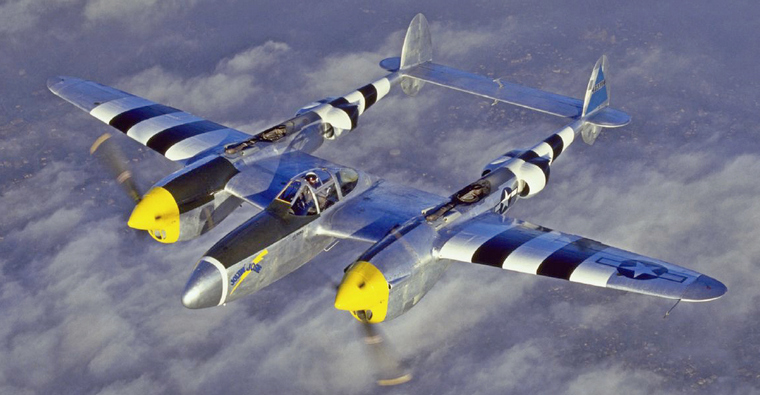
When one thinks WWII and Lockheed the image that instantly spring to mind is the company's highly successful unconventional twin boom P-38 Lightning. In the Asiatic-Pacific and China Burma India theaters of operation the Lightning was the aircraft flown by America's top flying aces: Richard Bong (40 victories), Thomas McGuire (38 victories), and Charles H. MacDonald (27 victories).
Introduced in July 1941 in Europe the P38 served in various aerial warfare roles including as a highly effective fighter-bomber, a night fighter and a long-range escort fighter when equipped with drop tanks. The P-38 was also used as a bomber-pathfinder, guiding streams of medium and heavy bombers.
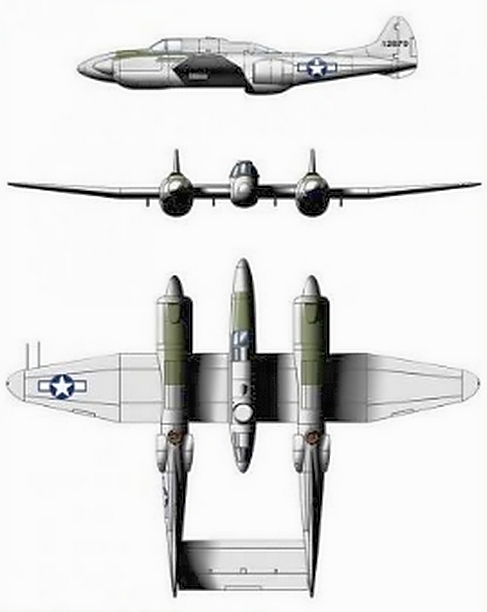
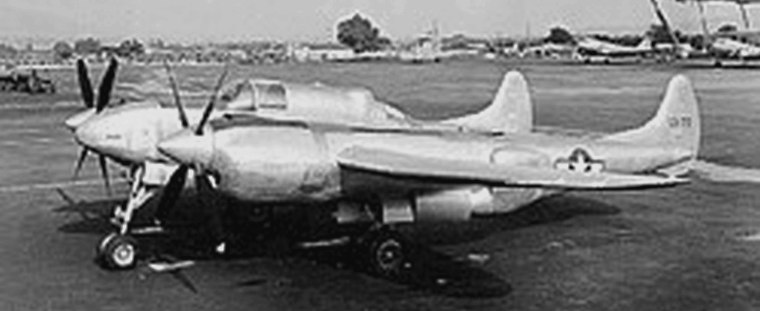
Derived from the P-38 the XP-58 Chain Lighting had its first flight on 6 June 1944, incidentally the same day as the start of Allied invasion of Europe. The idea to develop a twin engine long range fighter had its origin when in 1940 the first P39's where sold to the UK.
A Lockheed funded initiative the P38 platform was used to developed the XP-58. Two designs were formulated; one would be a single-seat aircraft with one 20 mm (.79 in) cannon and four .50 caliber (12.7 mm) machine guns. The second would be a two-seat aircraft with the addition of a flexible .50 caliber (12.7 mm) gun at the end of each tail boom.
Test revealed that the XP58 will be underpowered by the companies' original choice of engines, Continental's IV-1430, forcing the company to look for alternatives and it decided on Pratt & Whitney's XH-2600. That came to a quick end when development of the XH-2600 engine was terminated. The design was gain chanced, this time to accommodate two Wright R-2160 Tornado engines. Further chances were to the rear facing armament to two turrets, one upper and the other lower on the fuselage, each turret containing two .50 caliber (12.7 mm) machine guns.
In March 1942, the USAAF placed an order for a second XP-58. However, the US Air Force was uncertain about the role and armament of the aircraft and the second XP-58 was subsequently canceled and the role of the design reverted to that of a high-altitude fighter, using large-bore cannon firing high-explosive shells to break up bomber formations.
In January 1943, the USAAF initiated a separate program to build a dedicated photographic reconnaissance aircraft with superior range, altitude and speed characteristics. Lockheed proposed a modified version of the XP-58. However, the Hughes XF-11 won but plagued by technical and managerial delays it never entered service. The Northrop F-15 Reporter, a development of the P-61 Black Widow, would enter service in this role.
In February 1943 another engine chance due to poor progress with the Tornado engine development forced Continental to again search for a suitable power plant for then by then their problematic development of the XP-58. This time they settled on the Allison V-3420. It is with the Allison that on 6 June 1944 the XP-58 had its first flight. It eventually completed 25 test flights after which she was flown to Wright Field for USAAF acceptance tests. Arriving on 22 October 1944, the aircraft was a maintenance headache and no further trials were conducted. The construction of the second prototype was abandoned.
The fate of the XP-58 Chain Lightening was not the only one that has happened in the history of the development of new aircraft and it is not the last. This trend will most likely increase over the next number of years as the rapid development in Evtol, alternative power aircraft, drones and UAV's increase.