When, in 1969, Concorde was revealed to the world, this Anglo-French collaboration made global headlines. Sleek, elegant, and futuristic, it promised to usher in a new era of supersonic passenger travel.
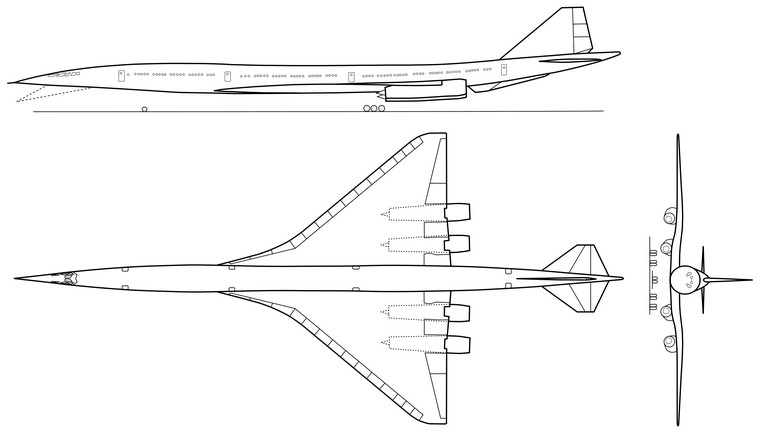
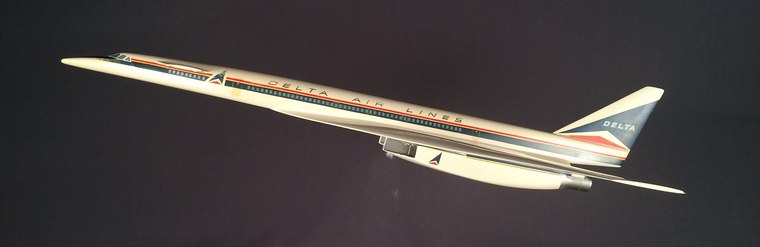
In response to what was then seen as the inevitable future of commercial aviation, the United States set out to build a faster, larger, and more capable supersonic airliner. Boeing, during the 1960s, won the government contract, and the Boeing 2707 Supersonic Transport (SST) project was launched, with development centred at the company's facilities in Seattle, Washington.
A full-scale wooden mock-up of the 2707 was constructed. It was envisioned to carry up to 300 passengers and cruise at around Mach 3-nearly three times the speed of sound. Unlike Concorde, the early design featured a variable-sweep (swing) wing, allowing efficient flight at both subsonic and supersonic speeds. However, this concept proved impractical and was later replaced by a fixed delta-wing design, similar in appearance to Concorde. Another shared feature was the distinctive droop nose, designed to improve pilot visibility during take-off and landing.
Despite its ambition, the SST programme quickly became a lightning rod for controversy. Environmentalists raised alarms about sonic booms and their potential to disturb communities and damage property, while scientists warned of possible harm to the ozone layer from high-altitude emissions. The airline industry itself was sceptical, questioning whether such an aircraft could ever operate profitably given its enormous development and operational costs.
By 1971, ballooning expenses, public opposition, environmental concerns, and the lack of a convincing economic case led the U.S. Congress to withdraw funding. The programme was cancelled before the two planned prototypes were completed.
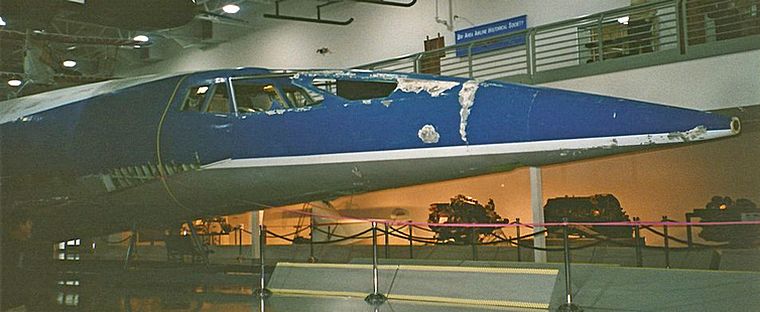
The 2707 mock-up survived, though not in the most dignified way. For years it stood deteriorating by a Florida roadside after the project's cancellation. Eventually it was sold to the SST Aviation Exhibit Centre in Kissimmee, Florida, where it was displayed from 1973 to 1981. When the property was later purchased by the Osceola New Life Assembly of God, the congregation famously held services inside the building with the huge mock-up still standing in place.
In 1990, the mock-up was acquired by aircraft restorer Charles Bell, who moved it in sections to Merritt Island for safekeeping. The forward fuselage later found a home at the Hiller Aviation Museum in San Carlos, California, before being relocated in 2013 to Paine Field, Everett, Washington. There, the Museum of Flight began restoration efforts to preserve this unique relic of Boeing's supersonic dream.
Today, the Museum of Flight in Seattle displays a British Airways Concorde, parked only a few blocks from where Boeing's 2707 mock-up was originally built-an evocative reminder of a time when the world's leading nations raced to conquer supersonic travel.
While the Soviet Tu-144 saw only limited service, Concorde proved successful enough to operate as a luxurious transatlantic fleet from 1976 to 2003, with British Airways alone generating £1.75 billion in revenue from lifetime operating costs of £1 billion.
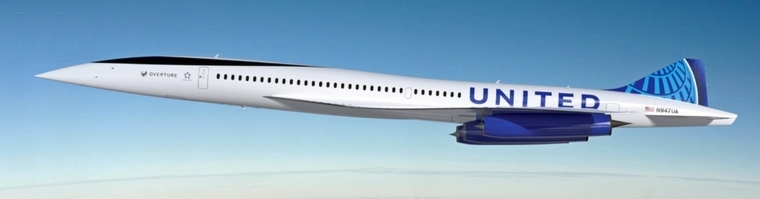
Yet, supersonic passenger flight may not remain a memory forever. The American company Boom Supersonic is currently developing its Overture airliner-designed to cruise at Mach 1.7, carry 60-80 passengers, and operate entirely on Sustainable Aviation Fuel (SAF). Its smaller demonstrator, XB-1, completed supersonic flight tests in early 2025, validating Overture's design. With rollout targeted for 2027 and commercial service planned by 2029, and orders already placed by United Airlines and American Airlines, the dream of supersonic travel may once again take to the skies-this time, cleaner, quieter, and more sustainable than before.
If your business wants to connect directly with the most engaged and influential audience in South African aviation, there's no better platform than Pilot's Post Online Aviation. In 2024 alone, we published 48 Midweek Updates and 192 in-depth Sunday feature reports, keeping readers informed, inspired, and invested in the latest developments across the aviation world. We remain the only South African publication providing daily coverage from Oshkosh and most major UK airshows, giving our audience exclusive insights they can't find anywhere else.
Over the past 14 years, we've produced an unmatched 3,729 articles and reports, building a reputation for credibility, quality, and consistency that both readers and advertiser's trust. No other aviation publication in South Africa can rival our reach, depth, or engagement and none can offer better exposure at more affordable rates. Whether you're launching a new product, promoting a service, or strengthening your brand presence, advertising with Pilot's Post ensures your message soars directly to the people who matter most in aviation.
Take your marketing to new heights-advertise with Pilot's Post and be part of South Africa's leading aviation voice.
Contact Willie on 082 442 8815 for a free no-obligation quote, and unbeatable value!
Tedderfield Airpark Summer Time Fly In 23 Nov 2024 659